
Insights · Belgrade
If you were opening a café in Vračar, where would you put it?
Vračar is one of Belgrade's best-loved neighbourhoods, and it already has a café on almost every corner. We wanted to see where a new one would do best, so we scored every address in it: all 5,071 of them.
Every address, one score
We gave each house number in Vračar the same score our free location check gives any address in the world, from 0 to 100. The score looks at what is around the address within 500 metres and how much each thing matters for a café: shops and other businesses, places visitors go, offices, bus and tram stops, schools and universities, and how easy the streets are to reach. Small deductions apply for steep streets and barriers such as the motorway.
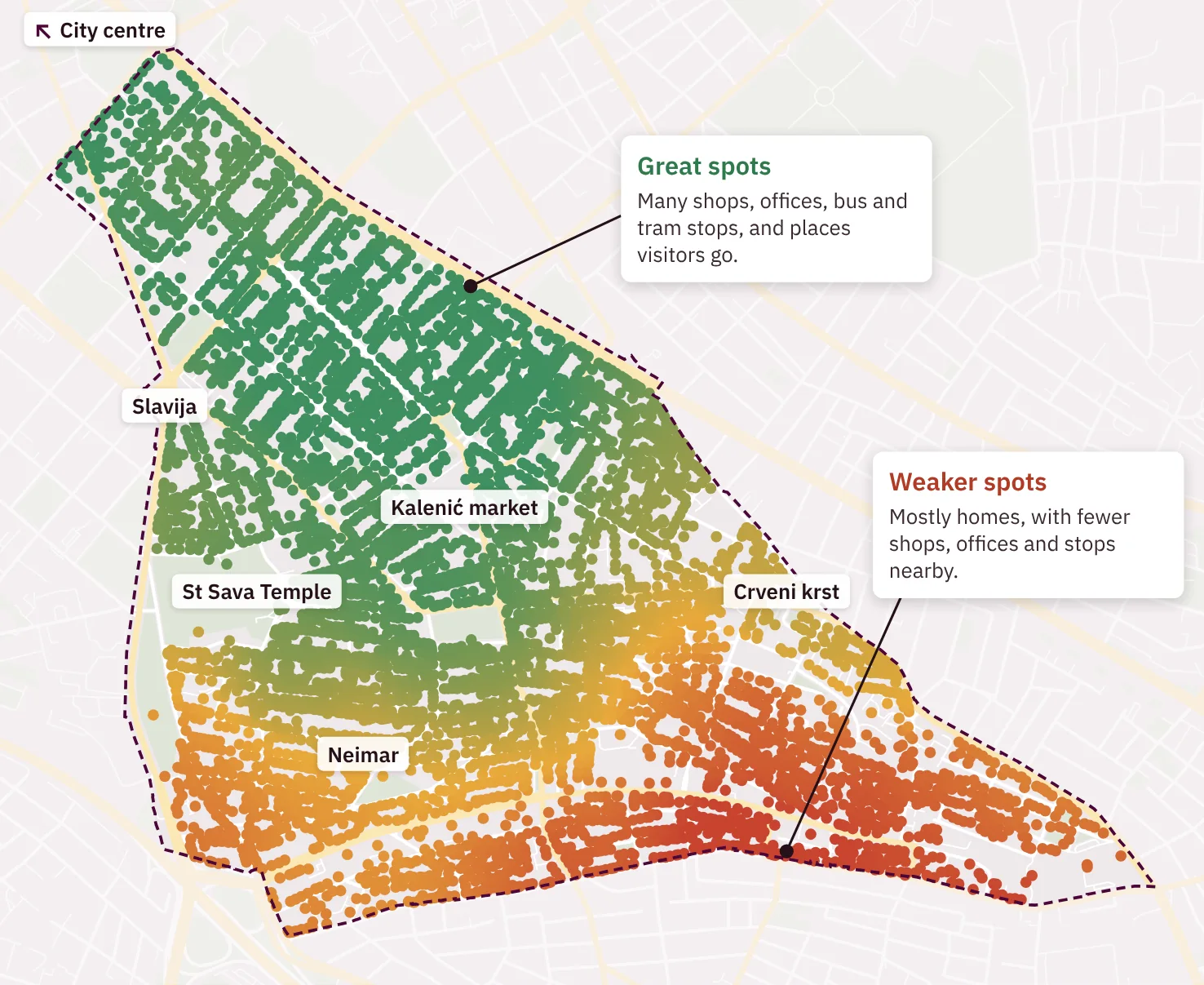
The north wins easily
Around Slavija and Kalenić market, the score is high almost everywhere. Walk ten minutes south, towards Južni bulevar, and it drops. The difference is not the neighbourhood's charm, but what is within a short walk of each door.
| Within 500 m (median) | Weakest fifth | Strongest fifth |
|---|---|---|
| Businesses | 106 | 677 |
| Restaurants, cafés and bars | 23 | 132 |
| Offices | 8 | 69 |
| Bus and tram stops | 12 | 28 |
| Hotels and attractions | 3 | 8 |
Addresses split into five equal groups by their café score.
The south is mostly homes. That is good for a bakery or a corner shop, but a café that lives from people passing by, office workers on a break and visitors finds far fewer of them there.
Does it match where cafés already are?
A score is only useful if it agrees with what the market has already decided. Vračar has 130 cafés on the map, and most of them are exactly where the score is high: 69% sit at addresses that score as great spots, although only 43% of all addresses do.
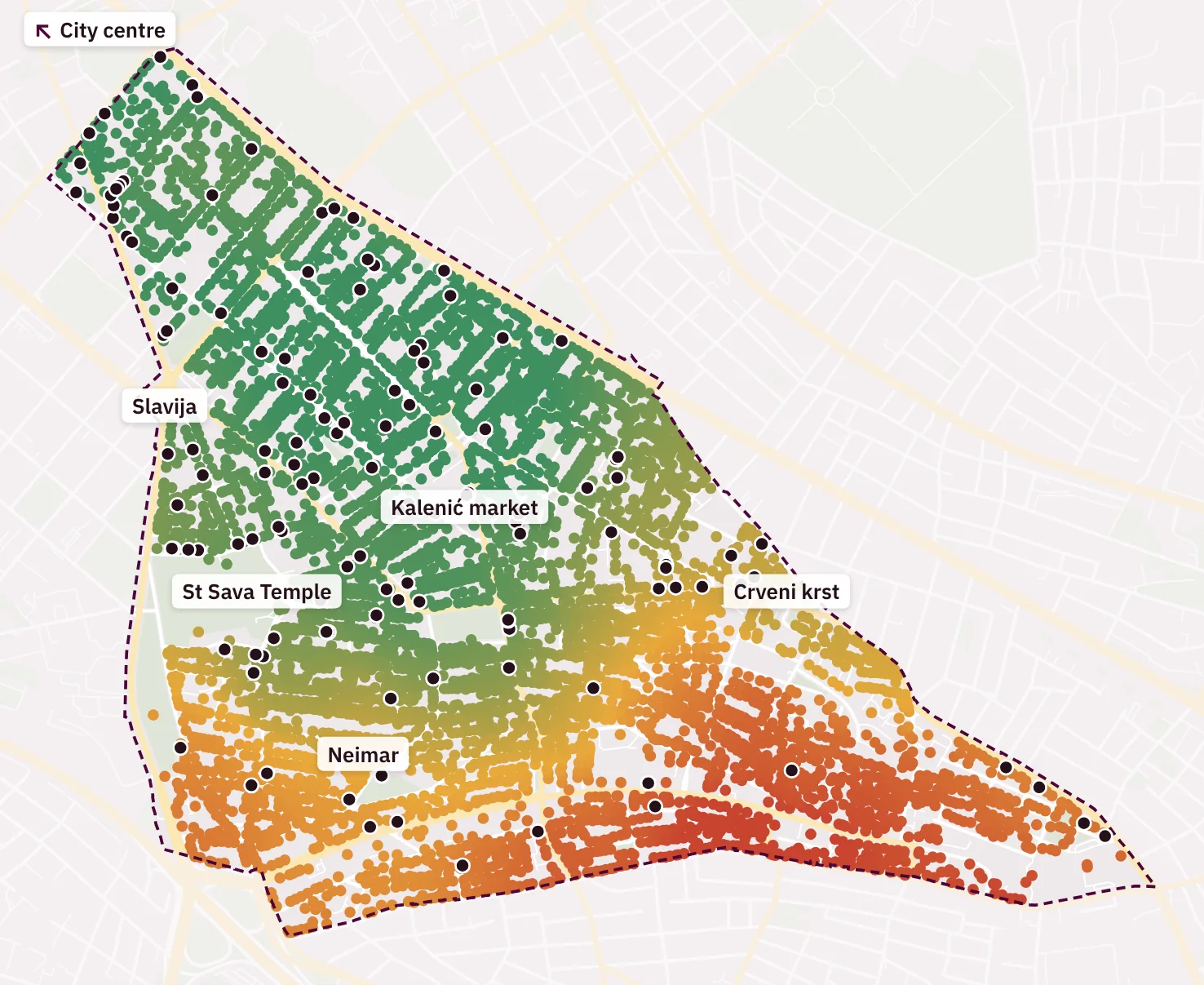
Existing cafés per 100 addresses, by the address score. Cafés are themselves part of the "businesses nearby" the score counts, so the match is partly built in; the trend is still clear.
What the score can't see
- Residents. For a café, the score weighs passers-by, offices and visitors, not the people living in the blocks around. A neighbourhood café that lives from its regulars can do well in the quieter south.
- Street by street. Each address looks 500 m around it, so neighbouring streets get similar scores. The map shows zones; a corner on a busy street and a quiet side street a block away can be very different places.
- Rent, footfall and the space itself. Open map data doesn't know what a lease costs, how many people actually walk past, or whether the unit has a terrace.
What this means for a new café
The busiest zones are also the most crowded with cafés. Some owners will want to be where people already are; others will look for a good street in a weaker zone with less competition. Either way, it helps to see the whole neighbourhood before choosing one door, and then to look closely at the few addresses that are left.
How we measured it
- Addresses: all 5,071 active house numbers in the municipality of Vračar, from the address register of the Republic Geodetic Authority of Serbia (RGZ).
- Score: the same café score as the Locoft free location check, computed for every address from one copy of the map data instead of one check at a time. Three addresses were also run through the live check, and the scores matched exactly.
- Map data: businesses, offices, schools, stops, hotels, streets and barriers from OpenStreetMap (November 2026); slope from open global elevation data.
- Existing cafés: the 130 cafés mapped in OpenStreetMap inside Vračar, each matched to its nearest address.
All figures are estimates based on open map data. Shops and cafés that are missing from the map are not counted.
How does your street score?
Our free location check scores any address in the world for a café or 14 other business types. For a full study of a site, a street or a whole network, talk to us.